


Digital Signal Processing (DSP) in Professional Audio Systems
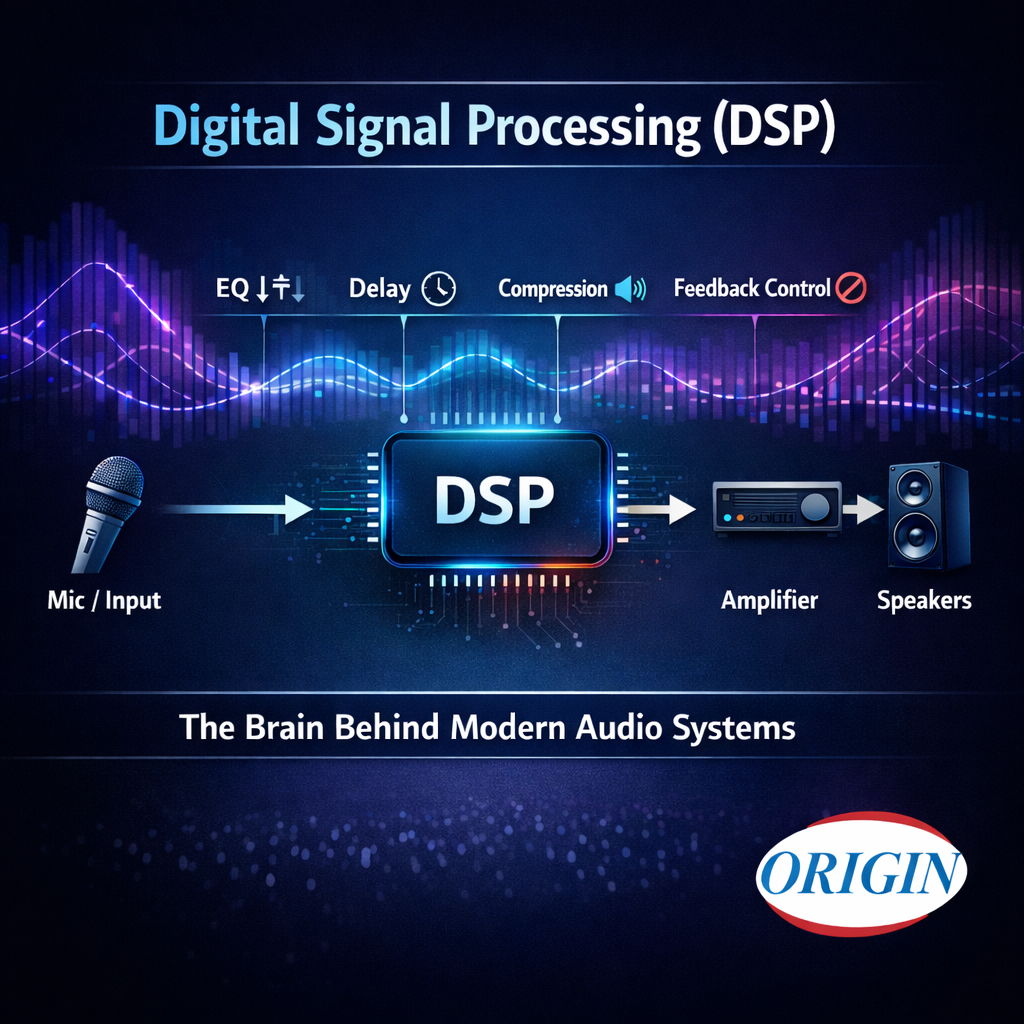
In modern professional AV installations, audio quality is no longer defined solely by microphones and loudspeakers. The real intelligence of an audio system lies in its Digital Signal Processing (DSP) architecture. From conference rooms and auditoriums to command- and-control centres and large educational campuses, DSP forms the backbone of audio clarity, stability, and intelligibility, while also enabling system consolidation by reducing the need for multiple standalone processing units, optimizing rack space utilization, improving thermal management, and enabling more efficient and scalable rack system design.
For audio consultants and system designers, understanding DSP is critical—not just at a feature level, but at an architectural and algorithmic level. This blog explores DSP in professional audio systems from an engineering perspective, covering signal flow, processing blocks, performance parameters, and real-world design considerations.
Digital Signal Processing refers to the real-time manipulation of audio signals after analog-to-digital conversion (ADC) and before digital-to-analog conversion (DAC) or digital transmission.DSP enables:
• Controlled gain structure
• Noise and echo mitigation
• Acoustic optimization
• System scalability and routing flexibility
• Consistent performance across environments
Unlike analog systems, DSP-based architectures provide repeatability, precision, and immunity to cumulative noise, making them indispensable in modern AV projects.
Current DSP Trends :
1. AI-Driven Audio Processing and Intelligent DSP Trend:
Modern DSP systems increasingly integrate AI and machine learning to automatically optimize sound processing. AI-based DSP can identify speech vs noise, auto-adjust EQ, and dynamically optimize audio based on environment and usage context.
• In hybrid meeting rooms and boardrooms, AI DSP suppresses background noises like keyboard typing or HVAC noise.
• In VC platforms, AI DSP enables real-time speech enhancement and noise separation for clearer remote communication. Example: Real-time AI noise suppression software can separate speech from background sound during live calls.
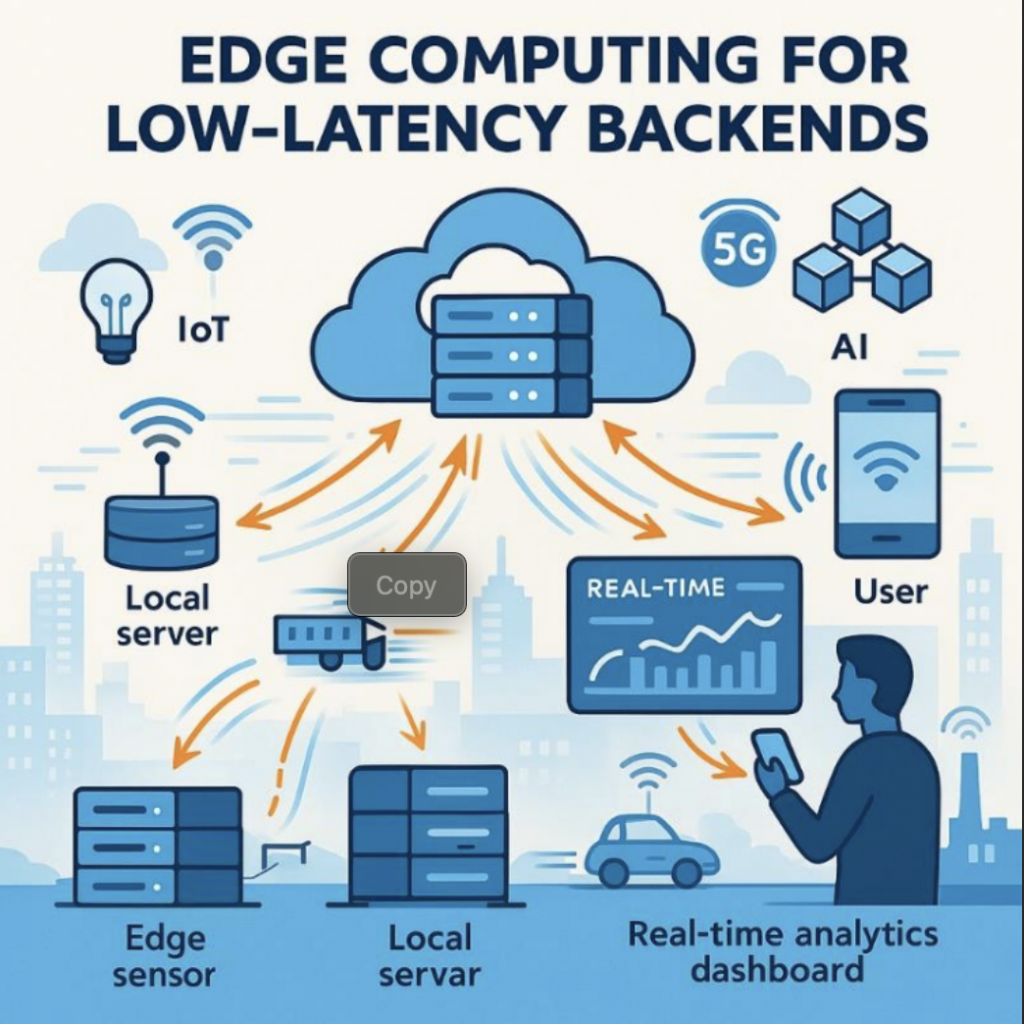
2. Edge DSP and Low-Latency Real-Time ProcessingTrend:
DSP processing is moving from centralized cloud systems to edge devices, enabling real-time processing with minimal latency.
• In auditoriums and live events, edge DSP performs real-time feedback suppression and adaptive EQ.
• In emergency PA systems, local DSP ensures audio works even if network fails.
3. Adaptive Acoustic DSP (Self-Tuning Systems) Trend:
Modern DSP uses adaptive algorithms that automatically adjust EQ, delay, and compression based on room acoustic changes.
• In multipurpose halls, DSP automatically adjusts sound tuning when room occupancy changes.
• In classrooms, DSP adapts audio tuning when partitions open or close.
4. Cloud + Remote DSP Management Trend:
Cloud DSP allows remote configuration, monitoring, and real-time collaboration between engineers.
• Large enterprise campuses monitor multiple meeting rooms centrally.
• Integrators can troubleshoot remotely without site visits.
5. Audio-over-IP (AoIP) + Networked DSP Architectures Trend:
DSP is now tightly integrated with AV-over-IP and networked audio ecosystems like Dante, AES67, and ST2110.
• Smart campuses distribute audio across multiple buildings using network DSP.
• Broadcast and live production use IP DSP routing with scalable channel expansion.
6. Immersive and Spatial Audio Processing Trend:
DSP enables spatial audio (Dolby Atmos, binaural audio, AR/VR sound rendering).
• Simulation labs use spatial DSP for training environments.
• Experience centers use immersive sound for customer engagement.
Digital Signal Processor (DSP) – Real Project Scenarios
1. Corporate Boardroom – Video Conferencing
In a multinational corporate boardroom, DSP is used to manage multiple table microphones and loudspeakers while ensuring echo-free communication with remote participants.
Functions such as Acoustic Echo Cancellation (AEC), Automatic Gain Control (AGC), and noise reduction ensure consistent speech clarity, regardless of speaker position or voice level.
While DSP platforms provide powerful processing tools, their effectiveness depends on correct design, configuration, and continuous optimization. OTS ensures that DSP systems are not just installed, but engineered for long-term performance, adaptability, and reliability. By combining technical expertise, structured project execution, and lifecycle support, OTS enables organizations to achieve high-quality audio communication, operational efficiency, and future-ready AV infrastructure.
2. Auditorium & Conference Hall
For large auditoriums, DSP handles signal routing, delay alignment, and equalization across multiple speaker zones. By applying output EQ and time delay, the DSP ensures uniform sound coverage and high speech intelligibility (STI) from the front rows to the last row. OTS DSP solutions provide pre-designed auditorium and large-room configuration templates, reducing system design time and ensuring proven performance. They include factory-tested delay, EQ, and zoning presets that help achieve faster commissioning with predictable results. OTS platforms also support standardized network audio integration, making it easier to expand speaker zones or add overflow areas in the future. With built-in system monitoring, remote diagnostics, and firmware upgrade support, OTS DSP helps maintain consistent audio performance while reducing maintenance effort and operational downtime in large venue environments.
3. Government Meeting Rooms (Chairman–Delegate Systems)
In council and government meeting rooms, DSP manages digital chairman and delegate microphones, priority logic, and feedback suppression. Digital processing improves GSM immunity, eliminates RF interference, and maintains stable audio performance even in mobile-dense environments.
4. Educational Institutions – Smart Classrooms
In smart classrooms and lecture halls, DSP integrates lapel microphones, handheld microphones, and multimedia audio sources. DSP ensures automatic level balancing, minimizes background noise, and provides seamless audio distribution to local speakers and recording/streaming systems.
5. Command & Control Centers
In mission-critical control rooms, DSP enables low-latency audio routing, mix-minus configurations, and redundancy. This ensures uninterrupted, intelligible communication between operators, supervisors, and external stakeholders.
Why DSP is Critical in These Projects
• Improves speech intelligibility using filtering, EQ, and noise suppression algorithms.
• Enables Acoustic Echo Cancellation (AEC) for seamless full-duplex conferencing.
• Maintains consistent audio levels using Automatic Gain Control (AGC).
• Provides feedback suppression to prevent microphone-speaker loop noise.
• Compensates room acoustic issues using parametric equalization and tuning.
• Supports delay and time alignment for multi-speaker sound synchronization.
• Enables beamforming and microphone array processing for focused voice pickup.
• Allows flexible audio routing and matrix signal management.
• Reduces hardware dependency by replacing multiple analog processors.
• Enables remote monitoring, diagnostics, and software-based configuration.
• Provides preset recall for different room usage scenarios.
• Supports integration with SIP, VoIP, and unified communication platforms.
• Enables scalable expansion for additional zones, rooms, or endpoints.
• Supports AV-over-IP and networked audio architectures.
• Enables real-time adaptive processing based on environment changes.
• Improves system reliability and reduces commissioning time.
• Enables firmware and software upgrades without hardware replacement.
• Optimizes amplifier and speaker performance through digital crossover processing.
• Enhances hybrid meeting audio quality for both local and remote participants.
At OTS, DSP solutions help overcome most audio system challenges by providing pre-engineered, field-tested processing platforms that reduce design complexity, commissioning time, and integration risks. They include built-in algorithms for speech enhancement, echo cancellation, noise suppression, feedback control, and automatic gain management, ensuring consistent audio quality across different environments. OTS platforms also support standardized protocols for unified communication, AV-over-IP, and network audio, enabling seamless scalability and future expansion. With ready templates, remote monitoring tools, firmware upgrade support, and compatibility with certified microphones, speakers, and conferencing systems, OTS DSP solutions improve system reliability, reduce hardware dependency, and minimize maintenance efforts while delivering optimized performance for hybrid collaboration and real-time audio applications.
Planning or want to know more about professional Audio Systems? Reach out to us to discuss, design and deliver solutions that make collaboration effortless.
Contact us info@origintechserve.in
#dsp#digitalsignalprocessing#AudioDSP#SignalProcessing #AudioProcessing#OriginTechserve #AVIndustry #FutureOfWork