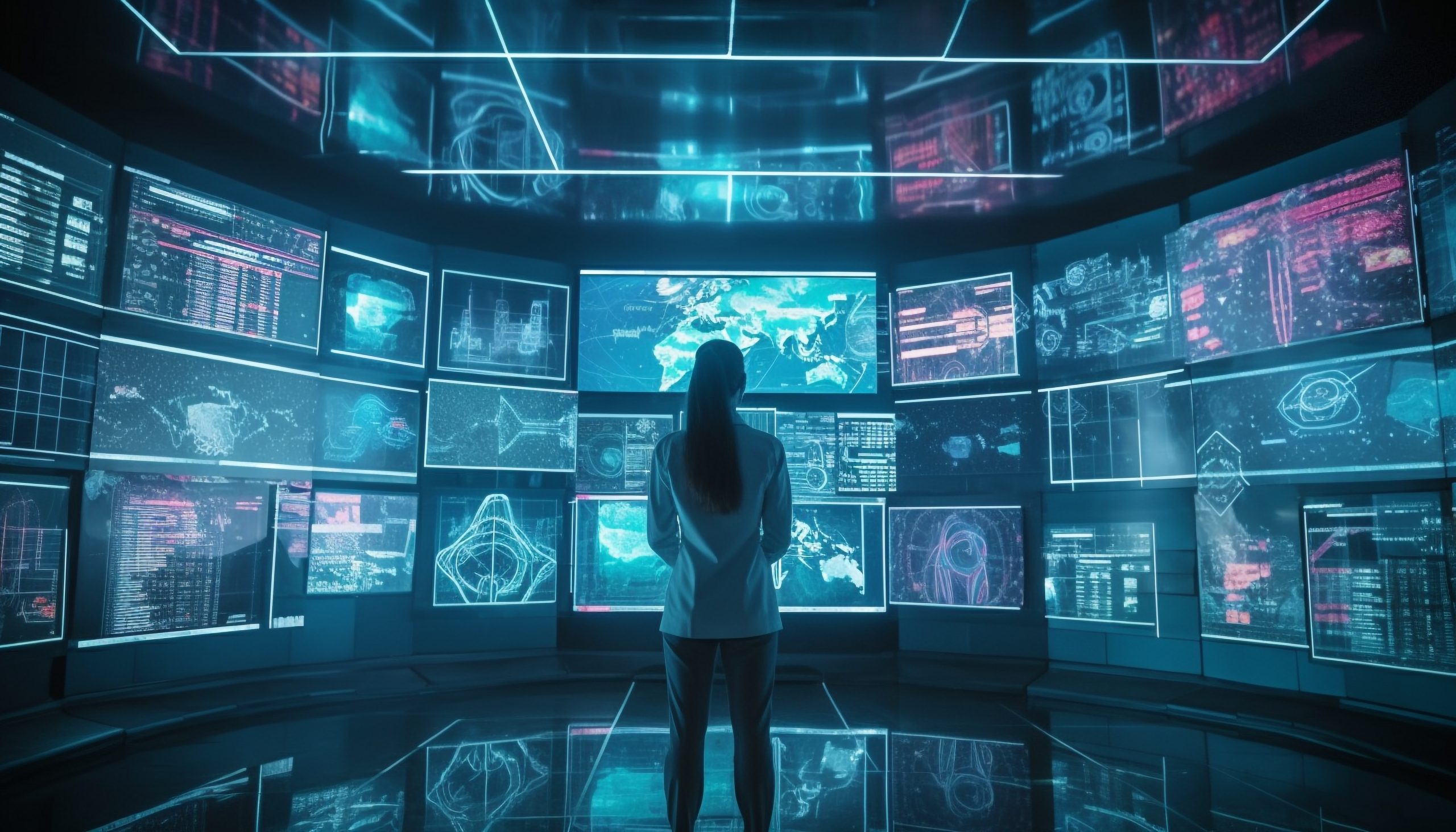



Case Study- Mission-Critical Control Room Modernization for Premier R&D Organization
Project Overview
This case study outlines the comprehensive modernization of mission-critical control rooms for a premier research organization. The client’s existing rear-projection displays had become obsolete and required an immediate upgrade to cutting-edge LED technology featuring robust power and data signal redundancy. Operating under strict, non-negotiable time constraints due to ongoing mission schedules, the engineering team successfully delivered a state-of-the-art visual ecosystem. By deploying premium Christie Digital 1.5mm pixel pitch LED videowalls and a high-end Extron XTP signal switching architecture, the project was completed one month ahead of schedule, establishing zero-downtime operations for crucial aerospace monitoring.
Client
The client is a high-profile, R&D organization operating under the Department of Space. Responsible for high-stakes aerospace engineering, satellite monitoring, and space exploration missions, their control rooms serve as the nerve center for nationwide strategic operations.
Industry
Research / Government
Project Duration
6-months
Customer Requirement & Challenges
The project presented a complex matrix of structural, logistical, and operational challenges:
- Continuous Operations: The client’s existing infrastructure—comprising two main videowalls (each with 5 obsolete rear-projection displays) and a dedicated mission monitoring room—remained fully operational. Demolition and installation had to occur without disrupting active aerospace missions.
- Massive Structural Requirements: The upgrade demanded the custom fabrication and erection of two heavy-duty Mild Steel (MS) structures, each spanning 18 meters in length, to securely support the new 15-meter primary LED videowalls.
- Geographic Dispersal: In addition to the main control rooms, the scope included integrating a separate, dedicated mission monitoring room equipped with 98-inch LCD display panels, alongside two smaller auxiliary LED videowalls (12 meters and 9 meters) at geographically distinct locations.
- Aggressive Timeline: The client mandated a strict 6 months window to complete the entire multiphase, multi-location rollout.
Solution Delivered
To overcome these rigid constraints, a hyper-structured project management framework was deployed, anchored by extensive stakeholder collaboration and engineering precision.
- Strategic OEM Alliances: The team engaged directly with industry-leading Original Equipment Manufacturers (OEMs)—Christie Digital and Extron Electronics—to lock in expedited production schedules, guaranteeing on-time delivery of premium display and signal-switching hardware.
- Custom Structural Engineering: An in-house design team engineered the bespoke 18-meter MS structural frameworks, performing rigorous weight distribution and load-bearing calculations to safely house the upcoming LED panels.
- Parallel Execution Teams: The project workforce was divided into two specialized project teams. Each team operated on strict, synchronized daily milestones across different locations to maximize installation efficiency.
- Pre-emptive Control Programming: While physical site preparation and structural erection were underway, the in-house programming team collaborated with Extron engineers to build, test, and refine the control system programming requirements off-site, reducing final commissioning times.
Implementation Highlights
• Complete design and engineering
• Installation and integration
• System programming and testing
• User training
• Documentation and handover
• Preventive support services
Results & Impact
Through meticulous planning, the project achieved exceptional outcomes, concluding inside 5 months against the 6-month deadline:
- Next-Gen Visualization Infrastructure: The team successfully erected the two 18-meter MS structures and installed two massive 15-meter Christie Digital LED videowalls. Each wall features 5 Full HD (FHD) resolution displays measuring 3 meters x 2 meters. The 12-meter and 9-meter auxiliary videowalls were seamlessly completed within the same timeframe.
- Ultra-High Clarity Display: Utilizing a 1.5mm fine pixel pitch, the new Christie LED walls provide high-contrast, ultra-realistic, and seamless visual outputs, which are essential for tracking minute data streams during space missions.
- Fail-Safe Video Routing: The AV backbone was built around an Extron Quantum Ultra processor coupled with a high-end XTP 64×64 CrossPoint Chassis Switcher . The system operates on a fully synchronized Primary and Secondary (redundant) mode, entirely mitigating the risk of video signal dropouts at any level.
- Zero-Downtime Power Redundancy: The Christie LED walls utilize advanced remote power supplies featuring N+1 redundancy. In the event of a power module failure, the system instantly switches loads without screen blackout.
- Hot-Swappable Maintenance: Technicians can replace failed power components while the videowall is fully operational (hot-swapping), ensuring zero system downtime during critical live missions.
Learnings
- Parallel Streamlining Mitigates Risk: Dividing a multi-site project into independent, synchronized project teams prevents bottlenecks at one location from delaying the entire project timeline.
- Off-Site Pre-Programming Saves Critical On-Site Hours: Developing and validating control system programming in a staging environment alongside OEMs removes programming latency during the physical installation window.
- Early Structural Customization Prevents Alignment Delays: Handing off architectural and MS structure designs to an in-house team early in the lifecycle guarantees that the structural foundations are perfectly true, level, and ready when the display hardware arrives.
- Hardware Redundancy Secures Client Trust: Designing fail-safes at both the signal routing level (Extron XTP) and the physical hardware level (Christie remote hot-swappable power) satisfies the strict requirements of mission-critical environments.